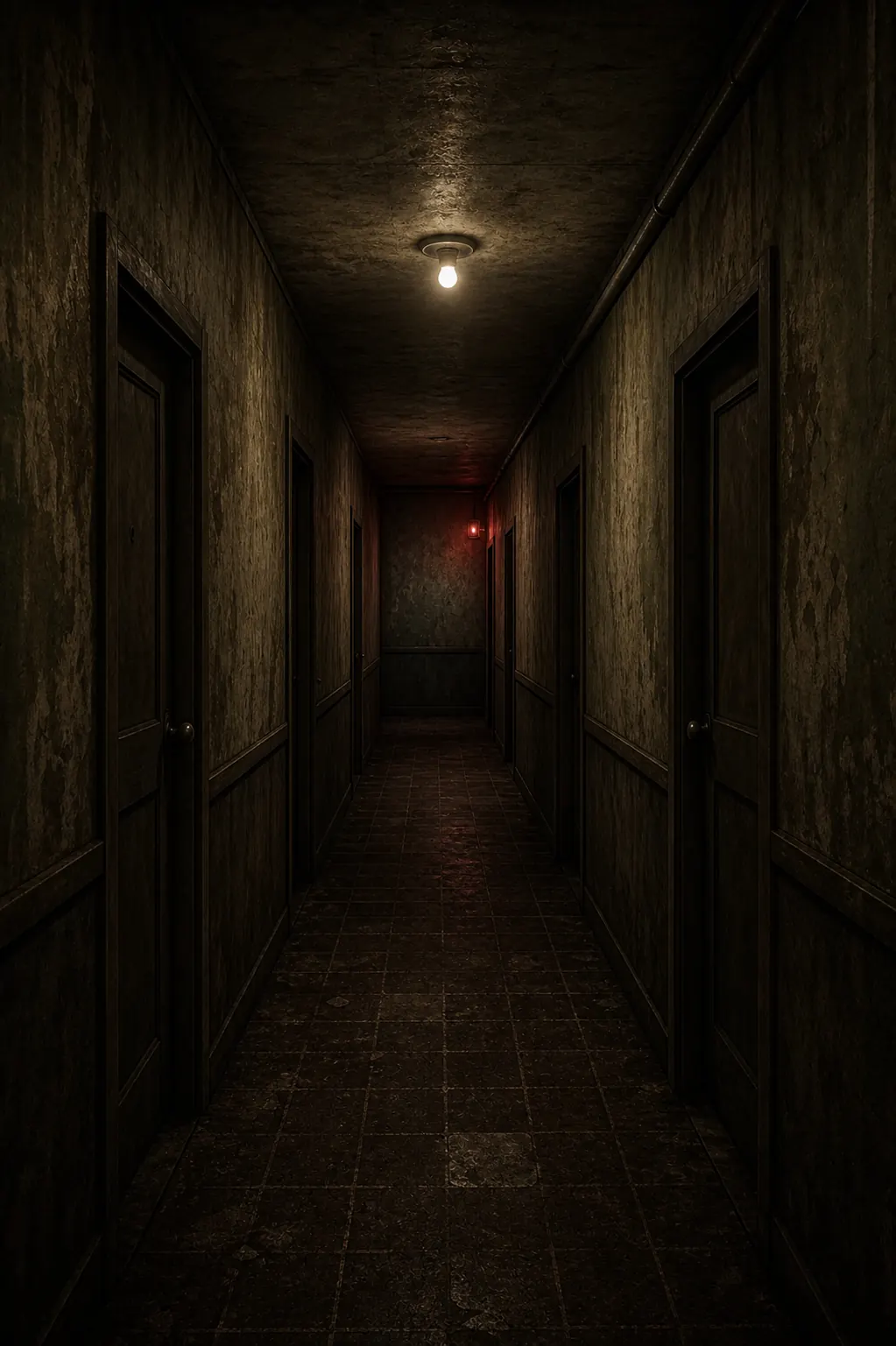
The room that should not exist
Three years ago, Hyejin abandoned the ROOM 404 game she had designed. Someone has now copied its structure and rules, summoning new participants into tests that exist outside ordinary entertainment.
The story begins at Room 404 of Seoul Motel. What looks like an old escape room quickly reveals a harsher rule: its devices were never designed to forgive a wrong decision.
Hyejin's trail
The first two spaces contain marks hidden in ways only Hyejin and the protagonist would understand. They prove that she prepared or passed through the facility before him.
From the third space onward, the marks disappear. The investigation becomes a source of anxiety: did she choose to stop leaving them, or did something prevent her from continuing?
Five connected episodes
Season One is planned as five episodes. Each has its own rooms and puzzle language, while every result advances the same mystery: where Hyejin went and who rebuilt ROOM 404.
- EPISODE 01 · The Missing Hyejin
- EPISODE 02 · Someone's Invitation
- EPISODE 03 · Replicated Memories
- EPISODE 04 · The Observer's Room
- EPISODE 05 · The First 404
The boundary of the public archive
This page contains only information safe to know before starting Episode One. Puzzle solutions, death conditions, and the final decision remain outside the archive so that records found during play can fill the gaps.
Hyejin is not simply someone to rescue. She designed and abandoned the original ROOM 404. Why another party turned that design into a qualification test, and how participants are selected, are central questions for later episodes.
What the qualification test measures
ROOM 404 is not a quiz that selects the person with the most facts. It observes what a participant trusts when information is incomplete, what evidence supports a risky action, and how a choice changes after failure. Even when two people clear the same device, the timing of their hints and the decisions they revise create different records.
The worn doors, blacked-out control room, repeating corridor, and stalled elevator are therefore more than horror decoration. Each space is arranged to reveal a habit of observation or judgment. The identity of the observer and the qualification being measured remain hidden, but the first escape marks the beginning of that observation rather than its end.