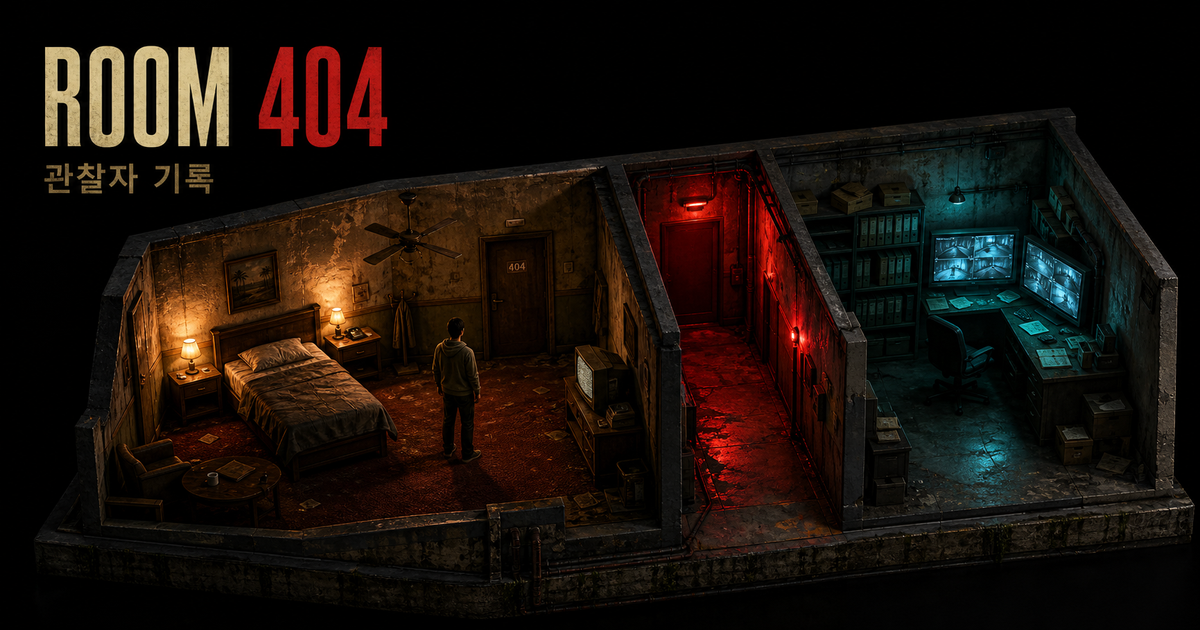
What we make
ROOM 404 is designed around why a player chooses an answer, not only whether the answer is correct. We review the story structure, puzzle rules, Korean and English wording, image hit areas, and sound timing as parts of the same experience.
We release on the web first to remove installation barriers and to improve real input problems across desktop and mobile quickly.
Production principles
Story revelations are delivered through records and deliberate gaps rather than exposition. Convenience UI remains a convenience; we do not force a fictional explanation onto every button and hint.
Images and external recordings are selected for the scene and interaction. Problems such as leading silence and duplicate sounds from one input are addressed by editing the recording or changing the playback conditions in code.
Release and improvement
Episode One is currently free and continues to receive fixes for clarity, difficulty, and compatibility. Significant changes are verified on a separate test deployment before reaching the live game.
How a feature reaches release
Checks are chosen for the affected behavior and reported by scope. Reproducing a particular saved state in a browser is different from playing the entire game from the first screen. A phone-sized browser test also does not replace checks on physical iPhone or Android devices.
External images and sounds are checked for usage terms and edited to the exact segment needed. Production records document failed approaches and decision criteria as well as the final result so later episodes do not repeat the same problem.
Work you can examine
ROOM 404’s production records are organized around specific problems in the game. The front-desk wiring board concerns reading a connection sequence on a small screen. Control-room sound concerns distinguishing power states. The hint system concerns avoiding instructions for actions already completed.
The useful question is not team size or the volume of work, but what was difficult in a scene and how a revision changes play. We distinguish creating a source image from adapting it for the game, and using an external recording from designing when and how it plays.